
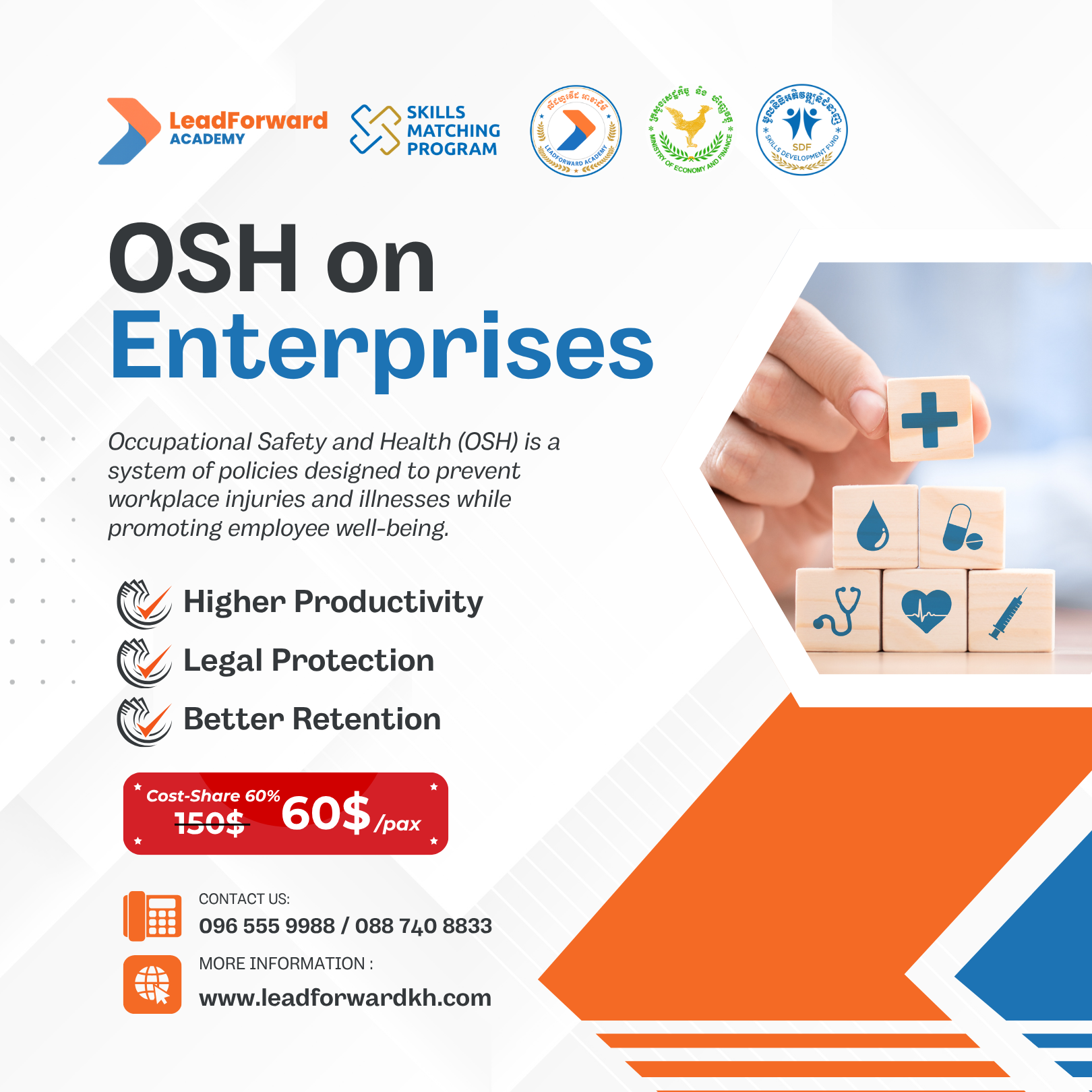
Objective
By the end of the course, students will be able to apply OSH concepts to real-world organizational settings and contribute to sustainable, safe, and healthy workplaces.
Learning Outcome
Here are typical learning outcomes for an Occupational Safety and Health (OSH) course. After completing the course, students will be able to:
Explain fundamental principles, concepts, and terminology in occupational safety and health
Identify and evaluate workplace hazards (physical, chemical, biological, ergonomic, and psychosocial)
Conduct risk assessments and recommend appropriate control measures using the hierarchy of controls
Interpret and apply relevant OSH laws, regulations, and standards
Design and implement workplace safety and health management systems
Promote safety culture, employee participation, and safe work practices
Use appropriate personal protective equipment (PPE) and recommend its correct selection and use
Develop emergency preparedness and response plans for workplace incidents
Investigate accidents and near misses, identify root causes, and propose preventive strategies
Address issues related to occupational diseases, health surveillance, and wellness promotion
Communicate OSH information effectively through training, reporting, and safety meetings
Demonstrate ethical and professional responsibility in protecting workers’ safety, health, and well-being
Course Content
Module 1: Introduction to OSH in Enterprises (Theory)
Duration: 1.5 Hours
Definition and scope of OSH
Importance of OSH for enterprises
Roles and responsibilities of employers and employees
OSH culture in the workplace
Module 2: OSH Legal Framework and Standards (Theory)
Duration: 2 Hours
Overview of OSH laws and regulations
Employer and employee obligations
National and international OSH standards
Compliance and enforcement
Module 3: Workplace Hazard Identification (Theory + Practice)
Duration: 3 Hours
Theory:
Types of workplace hazards (physical, chemical, biological, ergonomic, psychosocial)
Hazard identification methods
Practice:
Hazard identification exercise (photos, videos, or case scenarios)
Group discussion and reporting
Module 4: Risk Assessment and Risk Control (Theory + Practice)
Duration: 3.5 Hours
Theory:
Risk assessment process
Risk matrix and prioritization
Hierarchy of controls
Practice:
Conducting a basic risk assessment
Developing risk control measures
Module 5: OSH Management Systems in Enterprises (Theory + Practice)
Duration: 3 Hours
Theory:
OSH policy and planning
OSH committees and roles
Monitoring, reporting, and documentation
Practice:
Designing a simple OSH management plan
Group activity: OSH checklist development
Module 6: Accident Prevention, Emergency Response, and PPE (Theory + Practice)
Duration: 2.5 Hours
Theory:
Accident causes and prevention
Emergency preparedness and response
Personal Protective Equipment (PPE)
Practice:
PPE selection and use demonstration
Emergency response scenario simulation
Module 7: Review, Assessment, and Action Planning (Practice)
Duration: 1 Hour
Knowledge review
Short assessment/group presentation
Enterprise-level action plan discussion
Who is it for?
This training is designed for:
Employers and business owners
Managers and supervisors
Human Resource (HR) personnel
Safety and health officers
OSH committee members
Team leaders and line managers
Employees responsible for workplace safety
Enterprise representatives involved in compliance with OSH regulations
Training Method
Theory (9.00 hours) Practice (7.00 hours)
Minimum Entry Requirements
Participants should be employed in or familiar with enterprise operations
Basic literacy and communication skills
Willingness to participate in practical activities
No prior OSH certification required



© 2026 LeadForward Academy. All rights reserved.