
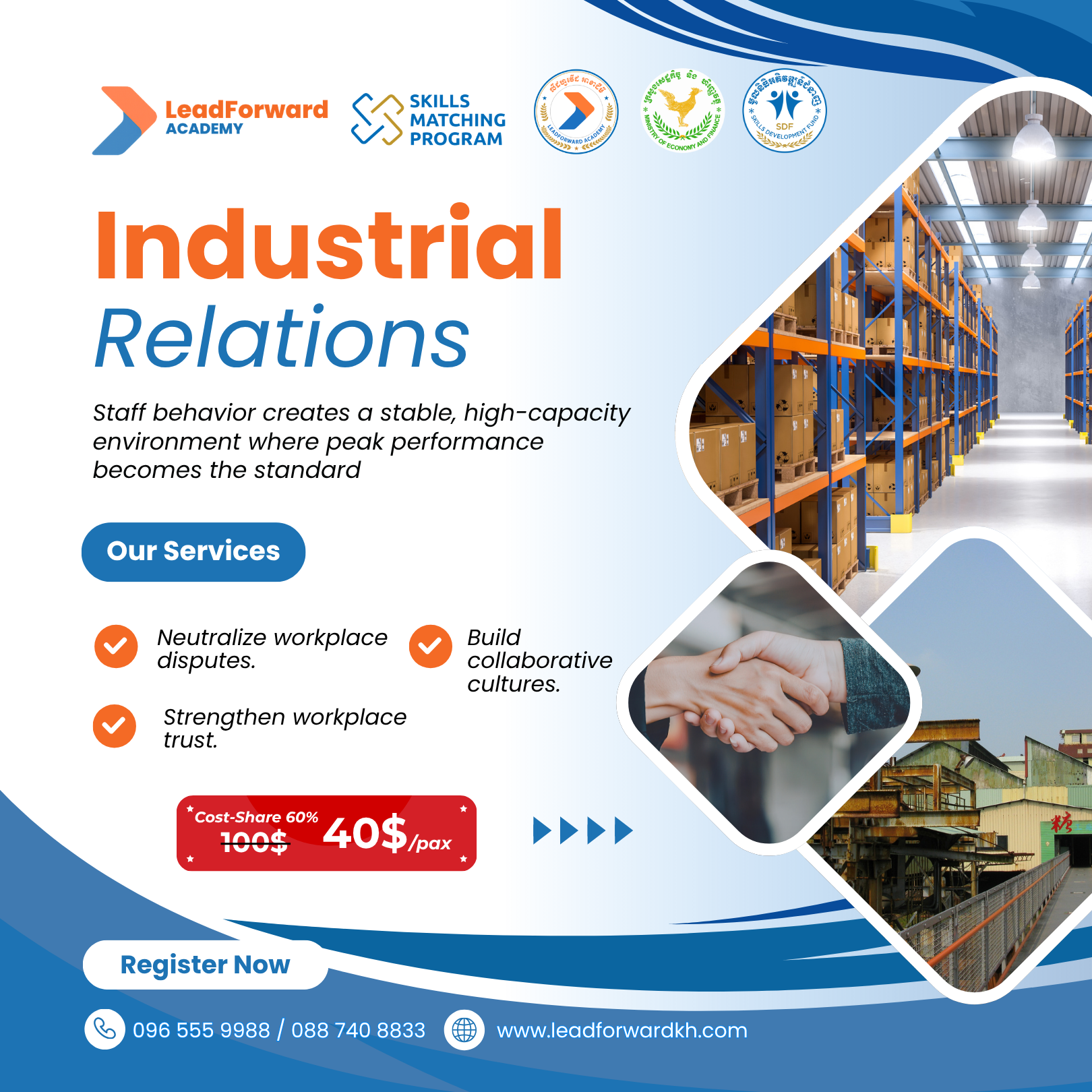
Objective
By the end of the course, learners are equipped to analyze industrial relations issues, promote cooperation between management and workers, and contribute to sustainable and fair workplace practices.
Learning Outcome
Here are typical learning outcomes of an Industrial Relations (IR) course. After completing the course, students are usually able to:
Explain the concepts, theories, and evolution of industrial relations
Understand the roles of employers, employees, trade unions, and the state in the employment relationship
Analyze labor laws, regulations, and institutional frameworks governing industrial relations
Apply principles of collective bargaining, negotiation, and workplace communication
Identify causes of industrial conflict and propose effective approaches to dispute resolution
Evaluate the impact of globalization, technology, and economic policies on labor–management relations
Develop skills in grievance handling, mediation, and arbitration
Promote ethical employment practices, employee participation, and workplace cooperation
Assess workplace health and safety, equity, and employee well-being issues
Conduct basic research on industrial relations issues and case studies
If you’d like, tell me:
your level (high school, undergraduate, MBA, HR professional), or
whether you need course objectives, syllabus topics, or exam questions
…and I can tailor it exactly to your needs.
Course Content
Module 1: Introduction to Industrial Relations (Theory)
Duration: 1 Hour
Meaning and scope of Industrial Relations
Importance of Industrial Relations in organizations
Key stakeholders (employers, employees, trade unions, government)
Objectives of Industrial Relations
Module 2: Legal Framework of Industrial Relations (Theory)
Duration: 1 Hour
Overview of labor laws and regulations
Rights and obligations of employers and employees
Role of government and labor institutions
Compliance and enforcement mechanisms
Module 3: Trade Unions and Collective Bargaining (Theory + Practice)
Duration: 1.5 Hours
Theory:
Concept and functions of trade unions
Collective bargaining process
Types of collective agreements
Practice:
Case study on collective bargaining
Group discussion on union–management relations
Module 4: Industrial Disputes and Conflict Resolution (Theory + Practice)
Duration: 2 Hours
Theory:
Causes of industrial disputes
Types of industrial conflicts
Dispute resolution mechanisms (conciliation, mediation, arbitration)
Practice:
Role-play: dispute negotiation between management and workers
Problem-solving exercises
Module 5: Employee Relations and Workplace Harmony (Theory + Practice)
Duration: 1.5 Hours
Theory:
Employee engagement and communication
Workplace discipline and grievance handling
Ethics and fair labor practices
Practice:
Group activity: designing a grievance-handling procedure
Scenario-based discussion
Module 6: Review, Assessment, and Feedback (Practice)
Duration: 1 Hour
Knowledge review
Short quiz or group presentation
Open discussion and feedback session
Who is it for?
General Manager
All Office Leaders in the enterprise and
Trade unions
Head of the Produce of workers
Training Method
Theory (4.50 hours) Practice (3.50 hours)
Minimum Entry Requirements
Basic understanding of workplace or organizational structure
Ability to communicate in English
Participation in group discussions and activities
No prior specialized knowledge in Industrial Relations required

© 2026 LeadForward Academy. All rights reserved.